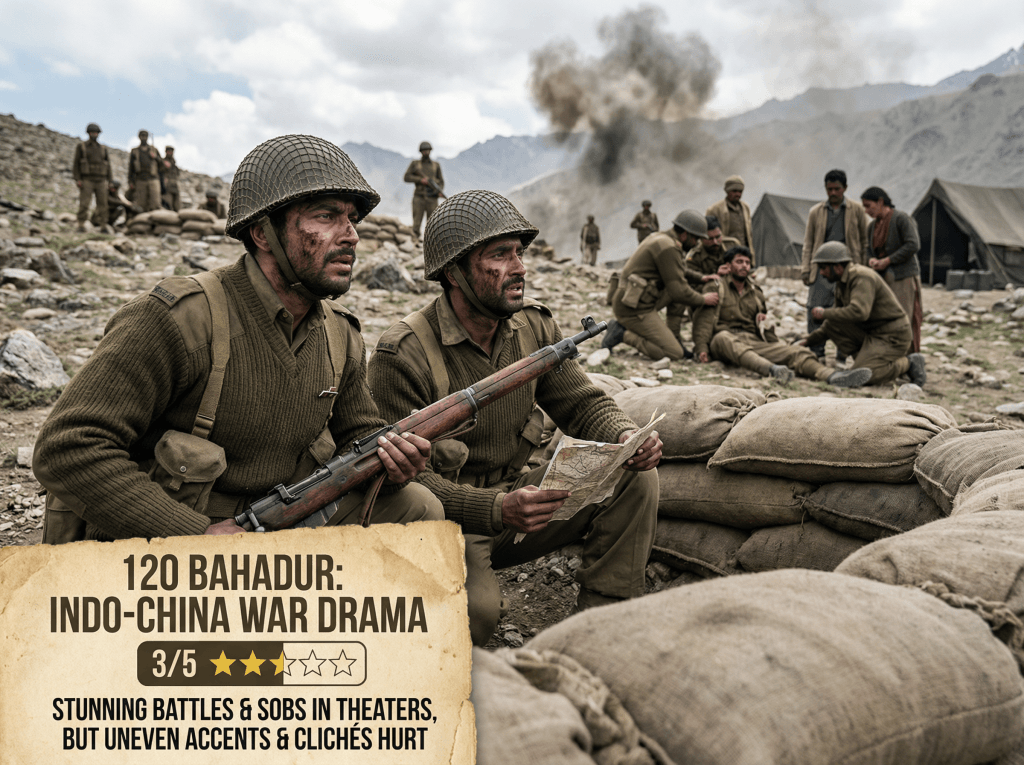
The film “120 Bahadur” captures the heroism of 120 Indian soldiers during the 1962 Indo-China War, delivering intense battle sequences and emotional depth that often bring audiences to tears. Directed by Razneesh “Razy” Ghai, this new Indian Army movie stars Farhan Akhtar as Major Shaitan Singh Bhati, leading Charlie Company of the 13th Kumaon Regiment in a desperate stand at Rezang La. While it earns a solid 3 out of 5 for its patriotic fervor and visual spectacle, uneven accents in portrayals and reliance on familiar clichés prevent it from reaching greater heights.
The True Story Behind 120 Bahadur
At the heart of the film lies the Battle of Rezang La, a pivotal clash in the 1962 Sino-Indian War where 120 valiant soldiers defended a strategic mountain pass in Ladakh against overwhelming Chinese forces. These men, mostly from the Ahir community, faced sub-zero temperatures, limited ammunition, and no artillery support while holding back an estimated 3,000 enemy troops. Their unyielding resolve halted the Chinese advance toward the Chushul valley, saving the region from potential occupation and earning Major Shaitan Singh the Param Vir Chakra posthumously.
The movie faithfully draws from this historical event, emphasizing the soldiers’ camaraderie and sacrifices amid harsh Himalayan conditions. It portrays the buildup of tensions along the border, with Charlie Company deployed to the exposed Rezang La post in November 1962. As Chinese movements intensify, the narrative shifts to the grueling defense, showcasing how ordinary infantrymen turned the tide through sheer willpower.
Plot Overview: Bravery Amid Frozen Horror
“120 Bahadur” opens in the snowy heights of Ladakh, where Major Shaitan Singh takes command of his unit just as winter escalates the border conflict. Flashbacks reveal his life in Jodhpur with wife Shagun Kanwar, adding personal stakes to the impending doom. The story builds to the fateful dawn assault on November 18, 1962, with waves of Chinese infantry launching a multi-directional attack under cover of artillery fire.
As the battle rages, the film depicts hand-to-hand combat, dwindling supplies, and the tragic fall of comrades, including young recruits facing war’s brutality for the first time. Only six soldiers survive the onslaught, their frozen bodies later found still gripping rifles in defiance. This Indo-China war movie blends raw action with moments of quiet reflection, reminding viewers of the cost of defending the motherland.
Farhan Akhtar’s Powerful Performance
Farhan Akhtar delivers a compelling portrayal of Major Shaitan Singh, embodying the officer’s quiet authority and unshakeable leadership under fire. His transformation into the battle-hardened hero, complete with a Jodhpur accent, anchors the film’s emotional core and draws inevitable comparisons to his role in “Bhaag Milkha Bhaag.” Supporting cast members, including first-time actors as the soldiers, bring authenticity to the platoons, with standout moments from characters like Sepoy Nihal Singh and Jemadar Surja Ram.
Raashii Khanna shines in her limited role as Shagun, conveying quiet strength through worried prayers and flashbacks that humanize the major. However, some Indian officers’ depictions feel stiff, while the Chinese antagonists come across as one-dimensional villains, lacking nuance in their aggression.
What Works: Stunning Battles and Emotional Pull
The film’s strongest suit is its gripping battle choreography, which immerses viewers in the chaos of Rezang La with dynamic camera work and realistic pyrotechnics. The last hour sustains high tension, evoking sobs in theaters as soldiers fight to their final breaths, fulfilling their oath to hold the line. Sound design amplifies the isolation, from echoing gunfire to the howling wind, making the high-altitude ordeal palpably real.
Patriotic undertones resonate without overwhelming the narrative, celebrating the ‘vardi’ (uniform) and ‘balidaan’ (sacrifice) that define Indian military lore. As a new Indian Army movie, it pays sincere homage to the 1962 war’s unsung heroes, inspiring pride in audiences familiar with the era’s geopolitical scars.
Flaws That Hold It Back: Accents and Clichés
Despite its merits, “120 Bahadur” stumbles with uneven accents that occasionally disrupt immersion, particularly in non-Jodhpur scenes where dialects feel forced or inconsistent. Clichéd elements, like a colorful Holi song in flashbacks reminiscent of older war films such as “Border,” come off as superfluous and pull focus from the core conflict.
The screenplay also glosses over strategic details, prioritizing emotion over tactical depth, which might disappoint history buffs seeking a more analytical take on the Sino-Indian War. Chinese characters border on stereotypical, portrayed as ruthless hordes without deeper motivation, reinforcing familiar Bollywood tropes.
Box Office Buzz and Viewer Reactions
Since its release, “120 Bahadur” has crossed the Rs 10 crore mark in its opening weekend, marking Farhan Akhtar’s fifth solo-lead film to achieve this milestone. Special screenings for Indian Army officials in Delhi highlight its resonance within military circles, underscoring the story’s enduring relevance. Viewer reactions praise the tear-jerking finale and Akhtar’s dedication, though some note it as a standard war drama lacking fresh insights.
As an Indo-China war movie, it revives interest in the 1962 conflict, blending education with entertainment for a broad audience. Families and history enthusiasts fill theaters, drawn by the promise of a heartfelt tribute to real-life bravery.
In summary, “120 Bahadur” stands as a worthy addition to Indian war cinema, balancing spectacle and sentiment while grappling with executional shortcomings. It’s a film that honors the past without reinventing the genre, leaving audiences moved yet wishing for more polish.

