Jaiprakash Power Ventures Ltd, commonly known as JP Power, experienced a sharp decline of 7.54% in its share price, closing at ₹20.01 on recent trading sessions. This drop pushed the company’s market capitalization to approximately ₹13,720 crore, reflecting investor concerns over short-term pressures in the power sector. With an earnings per share (EPS) of ₹0.89, the stock’s performance has drawn attention from traders monitoring recovery signals tied to its thermal power initiatives.
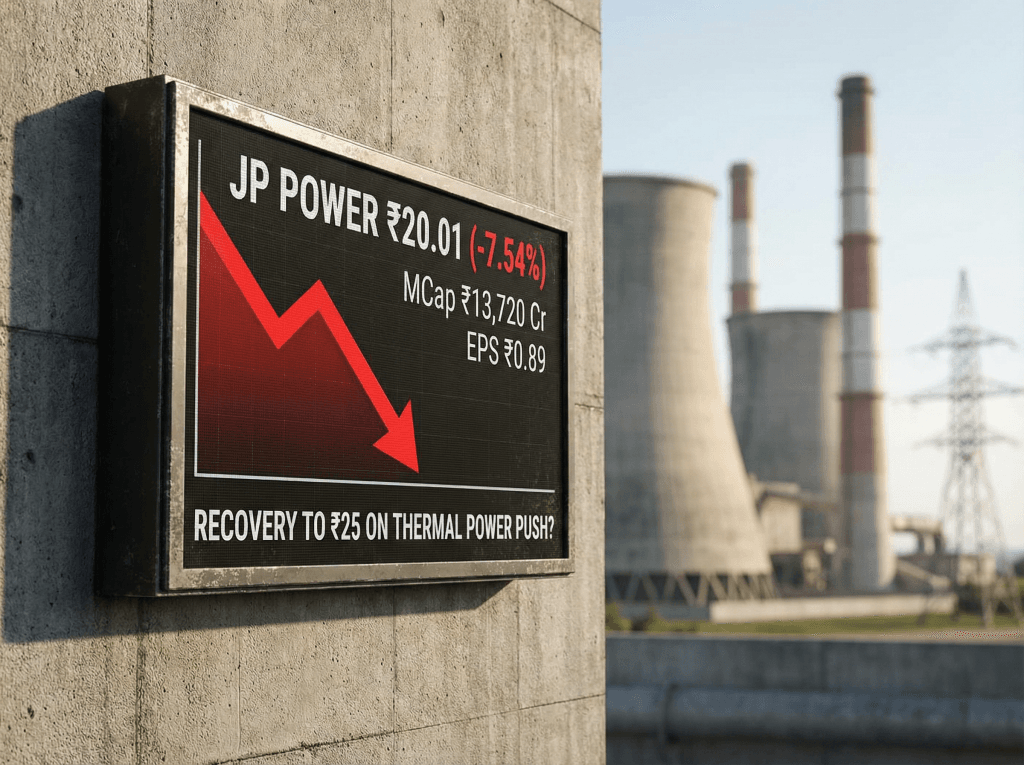
Recent Share Price Decline Explained
The JP Power share price tumbled after a brief rally, erasing gains from optimism around the broader Jaypee Group’s debt resolution efforts. Factors like profit-taking by short-term investors and the stock entering overbought territory contributed to the fall, halting a two-day surge of nearly 30%. Despite this, the stock remains within its 52-week range of ₹12.36 to ₹27.70, showing resilience in a volatile market. Current trading levels hover around ₹19.40 to ₹20.30, with high volume indicating active interest from retail and institutional players.
Company Fundamentals at a Glance
JP Power operates in power generation, including thermal and hydroelectric plants, with key assets like the 1,320 MW Nigrie Super Thermal Power Plant and the 500 MW Bina Thermal facility. The company’s market cap stands at ₹13,720 crore, supported by a book value of ₹18.59 per share and a price-to-earnings ratio of about 18.2, which is reasonable compared to sector peers like NTPC and Adani Power. Return on capital employed (ROCE) at 10.3% and return on equity (ROE) at 6.85% highlight steady operational efficiency, though sales growth has lagged at 10.7% over five years. No dividends have been paid recently, focusing resources on debt reduction and capacity expansion.
Thermal Power Push: Catalyst for Recovery?
JP Power’s emphasis on thermal power projects could drive a rebound to ₹25, fueled by stable coal linkages and increasing demand in India. The Nigrie plant, with its 2×660 MW supercritical units commissioned in 2015, benefits from dedicated coal from the Amelia North block, ensuring cost-effective operations. Recent quarterly results show net sales up 17.28% year-over-year to ₹1,438 crore, with profit after tax at ₹182 crore, signaling improving margins in power generation. Analysts note that resolving group-level debts, including potential asset transfers, may unlock value, positioning the stock for upside if thermal output ramps up amid India’s energy needs.
Challenges and Investor Sentiment
High promoter pledging at 79.2% remains a concern, adding to perceived risks despite profit growth of 20% CAGR over five years. The power sector faces headwinds from fluctuating fuel costs and regulatory changes, but JP Power’s debt-to-equity ratio of 0.44 indicates better financial health than in prior years. Community sentiment on trading platforms leans towards 67% buy recommendations, with forums buzzing about potential breakouts. Technical indicators suggest support at ₹19 and resistance near ₹21.68, advising caution for intraday trades while long-term holders eye thermal expansions for sustained recovery.
Outlook for JP Power Share Price
Looking ahead, JP Power’s share price could test ₹25 if thermal power initiatives gain momentum, supported by government pushes for reliable energy supply. With EPS at ₹0.89 and consistent quarterly profits, the stock offers value at current valuations below sector medians. Investors should watch for updates on debt restructuring and plant utilization rates, as these could stabilize volatility and attract fresh capital. Overall, while short-term dips persist, strategic focus on thermal assets positions JP Power for potential growth in the coming quarters.

